
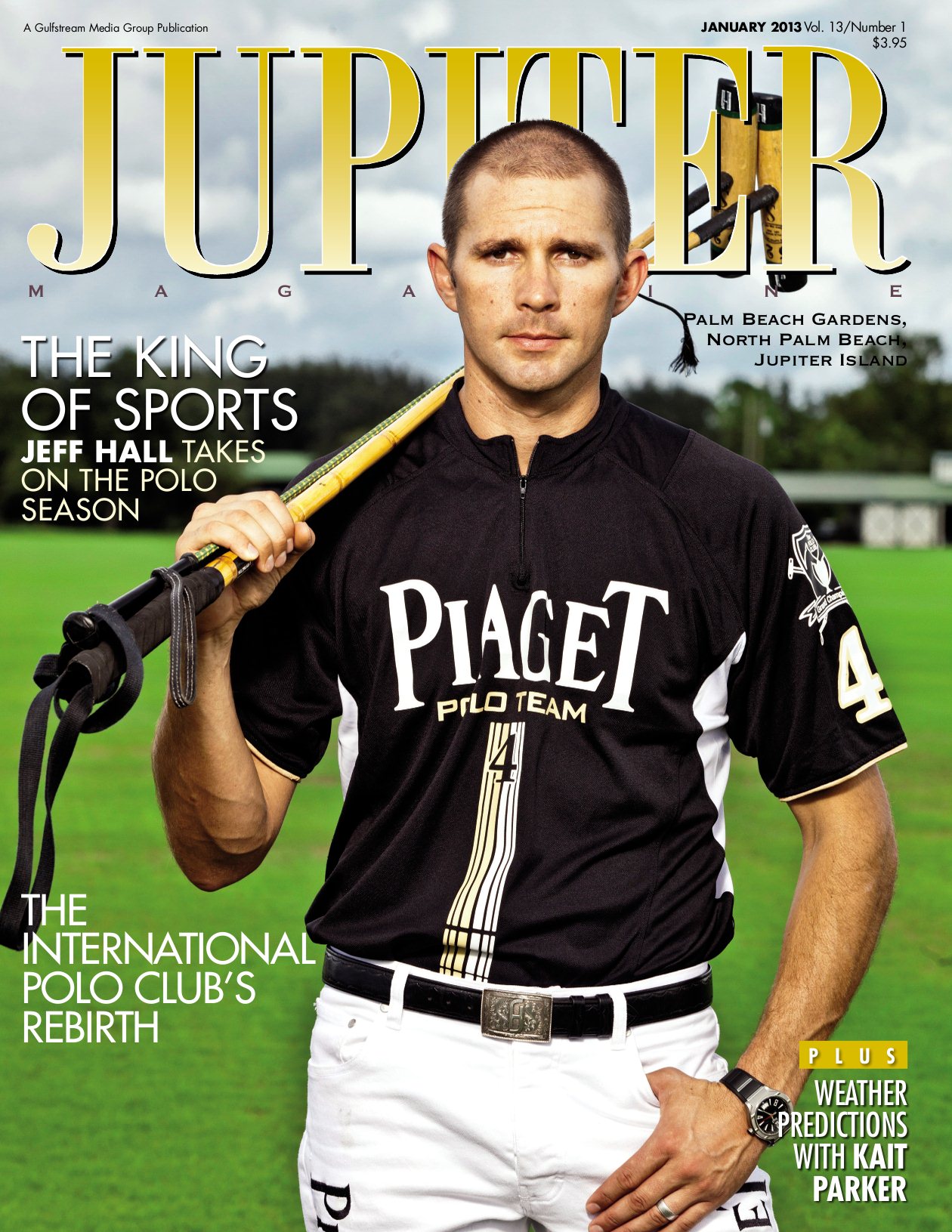
 On a field where horses trampling the ground create a cacophony of clip-clopping sounds, long-handled mallets are swung, and men compete in teams while riding animals that can reach body-crushing weights of a thousand pounds, professional polo player Jeff Stuart Hall is at home.
“I was born into this,” says Hall, whose father was in the polo business as a former player and sponsor of the sport.
Sitting on a chair in the dirt-road hallway of his Wellington barn, Hall is calm, cool and collected. The sun captures the light brown hue in his eyes while the wind, dancing to and fro, eases him into a further state of confidence. The sound of horses’ nickers – the soft neighs the majestic animals release – is the idyllic backdrop for the polo player as he discusses the origins of his career, a career that blossomed when he was just a toddler.
“I began riding horses when I was 4 years old,” says Hall, who was born in Tucson, Ariz. When Hall was just a child, his family moved to Santa Barbara, Calif., and it was there he tasted the sweet rush of playing in tournaments; he was only 7 years old.
Even as a small boy, Hall knew he wanted to be a professional polo player. “I’ve never taken another path,” Hall, 33, says.
In fact, polo is all he has ever known. His father, John, who bred horses and owned a ranch, provided Hall with the opportunities and resources he needed to focus on the sport. But by the time he was 12, his father recognized his son’s talent needed to be fostered by professionals. So when John left California and went to live in Texas, he made the supportive decision to send Hall to Argentina and train with the best.
For eight months Hall lived in a country known to produce unrivaled polo players, like Nacho Figueras and Adolfo Cambiaso. And for eight months Hall practiced and trained. While living there, a man named Cristian Laprida saw Hall play and invited him to play with Laprida in Greenwich, Conn.
Since then, Hall has never looked back. He traded a life of traditional schooling for home schooling and became a citizen of the world, traveling, competing all across the globe. “I never went to college; I didn’t mind, I hated school to be honest with you … anything to be outdoors, I would do,” he says with a hint of a smile.
For the handsome, 6-foot-2-inch athlete, polo is “like a drug.” It’s a passion he perfects on a weekly basis. He rides every day and goes to the gym three times a week, where he works on his leg core, lifts light weights and does cardio. The horses also consistently train. Twice a day, an hour in the morning, an hour in the evening, they are put to work.
But even though his horses are vigorously trained and worked, they are equally pampered. They receive constant companionship and grooming along with freshly cleaned stalls twice a day. Before each game, basil oil – a therapeutic lubricant said to provide anxiety relief – is applied to their noses, while their hooves are polished to perfection.
“The horses are taken care of, that’s for sure, better than most people take care of themselves,” Hall says of his horses, whose strict diets consist of hay, whole grains, alfalfa, vitamins and minerals.
When he takes them out to go play, the whole goal becomes winning, so Hall definitely maximizes the horses’ abilities. But once the match is over, the horses are then patched together, rehabilitated, and ready for the next game.
According to Hall, the horses play a pivotal role in the success of a polo player. “I always say it’s 100 percent the horse until you get to the ball; then it’s 100 percent you, and then it goes back to being
the horse,” Hall says. That is why he has taken it upon himself to breed horses in order to obtain the very best horses he can possibly have. So when his mares are done playing, they are sent to his 360-acre ranch in Houston and are bred with a stallion. It’s an expensive process, Hall says, that few polo players do, but it’s beneficial to ensuring he produces the purest of polo bloodlines. And although he also buys horses, his love lies in the breeding aspect of his business. On average Hall breeds eight horses a year, each of which carry a distinct brand – a combination of his three initials: J, S and H.
In polo, players are constantly changing teams, so a professional polo player is “like a team within a team.” So it’s important to be well-equipped. Hall owns all his horses, trucks and trailers. He has a crew that works for him and when he gets hired like an “independent contractor” to go play for a team, he’ll take with him eight to 10 horses; horses like Prana, Margarita and Christian.
While on the field, Hall is fearless. The only anxiety he feels is the overwhelming sensation of wanting to play, but he’s never nervous. By habitually riding, training his horses and himself, Hall and his crew do everything they can to prepare. So when game time rolls around, he’s ready.
Luckily, Hall has never experienced any major fractures or accidents – a fact he knocks three times on wood about. But even though that is the case, polo is very physical, dangerous and challenging. “Everyone has a big misconception of the sport. It’s the ‘Pretty Woman’ thing … people think of polo and they think of the movie,” Hall says of the film that portrays the sport as a strictly high-society event.
For more than two decades now, Hall, who currently holds a 7-goal handicap, has been playing professionally in an array of tournaments and has a voluminous number of wins under his belt. He has won the Bronze Cup in Spain, Pacific Coast Open, East Coast Open, the USPA Silver Cup on six separate occasions, and U.S. Open Polo Championship, all with Audi Polo Team.
But the most memorable wins of his career were the U.S. Open in 2003 and the Pacific Coast Open in 2009 because those were the tournaments he always dreamed of winning when he was a child.
In January 2013, the start of polo season, Hall will be playing at the International Polo Club Palm Beach. He’ll start with two 20-goal tournaments: the Joe Barry Memorial Cup and Ylvisaker Cup on team Orchard Hill, and end with three 26-goal tournaments: Royal Salute C.V. Whitney, USPA Piaget Gold Cup and the U.S. Open Polo Championship, all with Audi Polo Team.
For Hall, playing never gets old, and he’ll continue playing as long as he can. He craves the thrill of the game, the traveling that comes with it, and the occasional societal outing. But he would never recommend the sport to someone who didn’t share the same burning desire for the game. “This lifestyle is very appealing, but if you’re not good, you won’t make enough money to live a good life,” Hall says.
Hall believes the perfect recipe for a top-tiered polo player is talent, passion and great horses. If a player enthusiast lacks either one, then they are in for an uphill battle. But according to Hall, even far more important than great horses are the first two ingredients – talent and passion. “You have to have the talent, but if you’re not that passionate, you’re not going to be that good, period,” Hall says. So to the new polo-playing generation coming up he says, “Work hard, because if you’re not, somebody else is.”
Hall – an ambassador for luxury Swiss jewelry brand Piaget – splits his time between Houston and Wellington, but having recently purchased a home in Wellington, Florida is now becoming more of a home for him.
Between all the traveling, playing, breeding and spending time with his wife, Michelle, and 2-year-old, Luke, Hall has little time for anything else. But Hall wouldn’t have it any other way; he is blissfully content with how his life has turned out. “I couldn’t really ask for anything else … well, except for more horses, more kids and to win more tournaments,” he sweetly says.

